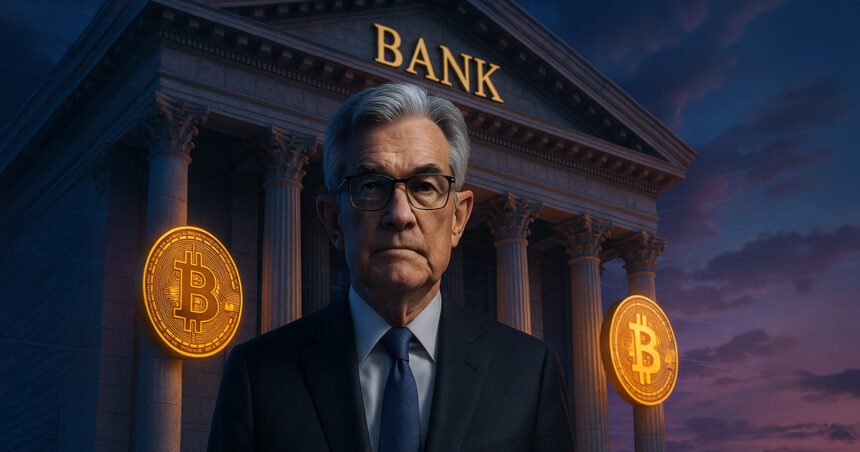
Jerome Powell stepped in entrance of cameras on Dec. 1 on the Hoover Establishment’s George Shultz memorial occasion with three audiences watching: bond merchants pricing an 87% probability of a December charge reduce, a divided Federal Open Market Committee bracing for attainable dissents, and a Bitcoin market that simply bled $4.3 billion from US spot ETFs in November alone.
The occasion billed itself as a tutorial panel on Shultz’s financial legacy. The market handled it because the final macroeconomic checkpoint earlier than the Fed’s assembly subsequent week and because the solely potential trace of whether or not the easing cycle will proceed or stall.
Bitcoin closed November at $90,360, down practically 20% from its October peak above $126,000, with on-chain information displaying worth buying and selling under key cost-basis bands and choices markets skewed towards draw back safety.
ETF flows turned modestly constructive on the ultimate buying and selling days of the month, with over $220 million in internet inflows.
Nonetheless, this reversal does nothing to offset the structural harm of a month that noticed BlackRock’s IBIT alone lose $1.6 billion between late October and mid-November.
The macro setup coming into Powell’s remarks is fragile: skinny liquidity, compressed positioning, and a market hypersensitive to any repricing of the Fed’s path.
What the market wants to listen to
Three questions dominate the FOMC assembly chatter. First, does Powell validate or cool the wager on a December reduce? The Fed has already reduce twice, in September and October, and futures markets worth one other 25 foundation factors this month with near-certainty.
But, Powell himself stated in October {that a} December transfer was “removed from assured,” and up to date reporting highlights an unusually divided FOMC with the potential for a number of dissenting votes if the committee eases once more.
The market desires readability: is he laying groundwork for a reduce, or organising a pause?
Second, how does he body the trade-off between inflation and development? Inflation stays above the Fed’s 2% goal, ISM manufacturing has contracted for months, and the federal government shutdown delayed key information releases just like the PCE report, leaving policymakers working with incomplete data.
Powell can lean into “disinflation is on monitor, development is slowing however manageable,” the candy spot that justifies simpler coverage with out triggering recession concern. Or he can emphasize sticky inflation and downplay the case for urgency.
The primary helps danger belongings, whereas the second reprices the curve.
Third, what does he sign concerning the path past December? The Fed stopped balance-sheet runoff on Dec. 1, successfully ending quantitative tightening.
That call already represents a shift towards lodging. Traders need to know whether or not Powell envisions extra cuts in 2026 or views December because the final transfer on this cycle.
Financial institution of America flipped its home name at present, anticipating a December reduce, adopted by two extra in mid-2026, citing softer labor information and dovish Fed rhetoric.
If Powell reinforces that view, it extends the easing narrative. If he pushes again, it compresses expectations and lifts actual yields.
How Fed indicators transfer Bitcoin
Each merchandise on that Fed watchlist now touches Bitcoin, however by completely different channels. Probably the most direct is the speed path itself.
Bitcoin trades as a high-beta macro danger amid decrease coverage charges and falling actual yields, fueling ETF inflows, stablecoin issuance, and risk-on allocations.
Analysis on cryptocurrency responses to financial coverage shocks finds that sudden tightening, measured as a one-basis-point shock rise within the two-year Treasury yield on FOMC days, correlates with statistically vital Bitcoin worth declines.
The inverse holds: shock easing that pushes short-rate expectations and actual yields decrease tends to raise BTC.
NYDIG’s October evaluation argued that actual rates of interest are the one most essential macro issue for Bitcoin.
Falling actual yields coincide with larger costs, and rising actual yields with sustained strain.
The sample since October validates that framework. After the Oct. 29 FOMC assembly, the place Powell refused to pre-commit to extra cuts, iShares’ IBIT noticed $1.6 billion in outflows over three weeks, together with a $447 million single-day redemption, as Bitcoin slid greater than 20% from its peak and traders rotated into gold.
That episode maps cleanly: hawkish trace, larger yields, ETF redemptions, BTC drawdown.
The steadiness sheet resolution issues for a second-order purpose. Stopping quantitative tightening retains greenback liquidity secure somewhat than draining it.
If Powell underscores that the runoff is completed and the Fed is snug sustaining or increasing its steadiness sheet, that may assist the “friendlier liquidity regime” narrative that has underpinned Bitcoin’s institutional adoption story.
If he hints at restarting QT down the highway, it turns into a headwind for danger belongings broadly.
The interior Fed cut up, political noise, stories of unusually excessive potential dissents, hypothesis about Powell’s 2026 successor, and rumors of White Home strain not directly have an effect on Bitcoin by elevating coverage uncertainty.
A visibly divided FOMC makes the speed path much less predictable, compressing danger urge for food and displaying up as uneven worth motion, thinner liquidity, and higher sensitivity to headlines.
If Powell sounds assured and united round a gradual easing path, it calms that volatility.
If he emphasizes independence or “information dependence” in a manner that reads as defensive, it flags extra turbulence forward.
The dealer’s map: three paths
Powell’s tone units up three conditional branches, every with a special implications chain from Fed-speak to actual yields to ETF flows to Bitcoin’s seemingly subsequent transfer.
A dovish shock consists of Powell clearly leaning into the case for a December reduce, sounding relaxed concerning the tempo of inflation, and opening the door to additional easing in 2026.
Two-year yields and actual yields fall as markets worth larger odds of each December and follow-on cuts.
One other path relies on ETF flows flipping. After $4.3 billion in November outflows, a dovish sign can cease redemptions and set off internet inflows as macro funds rotate again into liquidity trades.
In that situation, Bitcoin’s path skews towards a aid rally, reclaiming the high-$80,000s to low-$90,000s, and doubtlessly grinding larger if flows persist.
According to pricing, a 3rd path opens if Powell acknowledges a December reduce is “on the desk” however leans arduous on information dependence and refuses ahead steering.
FedWatch odds don’t transfer a lot. Actual yields chop however finish close to unchanged. ETF flows keep blended, with occasional small influx days just like the $70 million print that closed November, however no decisive development.

Bitcoin’s subsequent transfer in that case is extra about inner crypto positioning than Powell himself: with funding and open curiosity already compressed and on-chain metrics displaying an “under the band” overshoot, anticipate a uneven, mean-reversion regime round present ranges somewhat than a clear directional commerce.
Nonetheless, a hawkish tilt occurs if Powell performs down the necessity to reduce in December, focuses on upside inflation dangers, or warns that markets are “too assured” on fast easing. With FedWatch at 87%, even modest pushback can shock two-year yields larger.
That’s the kind of tightening shock the analysis hyperlinks to fast Bitcoin weak spot. The October template applies: a much less dovish-than-hoped Fed assembly, file IBIT outflows, BTC down greater than 20%.
A repeat would seemingly imply one other leg decrease from the mid-$80,000s, a minimum of a retest of latest lows, presumably a deeper flush if ETF redemptions speed up into skinny liquidity. That doesn’t break the longer-term construction, nevertheless it units up a “promote first, reassess later” response.
What’s at stake
The Shultz panel is tutorial window dressing. What issues for Bitcoin and the broader danger advanced is whether or not Powell validates the already-priced December reduce, indicators that the easing cycle extends into 2026, and reinforces the concept that the Fed is finished draining liquidity.
These are the levers that feed straight into ETF flows, stablecoin rails, and Bitcoin’s tape.
If Powell delivers the dovish affirmation markets need, the trail of least resistance is decrease actual yields and a aid rally off deeply oversold ranges. If he punts or pushes again, that reprices the curve, retains ETFs in redemption mode, and extends the drawdown till the market finds a brand new macro flooring.
Both manner, Powell’s Dec. 2 remarks are the final main Fed sign earlier than subsequent week’s assembly, and the clearest learn but on whether or not Bitcoin’s November ache was capitulation or just the start of a deeper reset.

PR
BC.GAME named Unique Gaming Accomplice of Crypto Combat Evening 2025
BELIZE Metropolis, Belize, December 2nd, 2025, Chainwire Crypto Combat Evening (CFN) has confirmed a partnership with BC.GAME, which can function the occasion’s Unique Gaming Accomplice for the…
18 hours in the past

PR
Mono Protocol Releases Presale Participation Replace for Stage 19
USA, New York, December 1st, 2025, Chainwire Mono Protocol has issued a brand new participation replace for Stage 19 of its ongoing presale spherical, reporting secure…
1 day in the past