
The Cocoon decentralized AI community, a privacy-preserving distributed computing platform constructed on The Open Community (TON) — an impartial layer-1 blockchain related to the Telegram messaging utility — went dwell on Sunday.
Cocoon permits house owners of graphics processing models (GPUs) to lease their computing energy to the community, processing consumer queries and requests in return for Toncoin (TON), the native token of the TON blockchain.
The decentralized AI community has processed its first requests from customers, and GPU house owners are already benefiting from renting out their {hardware}, in keeping with Telegram co-founder Pavel Durov. He stated:
“Centralized compute suppliers resembling Amazon and Microsoft act as costly intermediaries that drive up costs and scale back privateness. Cocoon solves each the financial and confidentiality points related to legacy AI compute suppliers.”
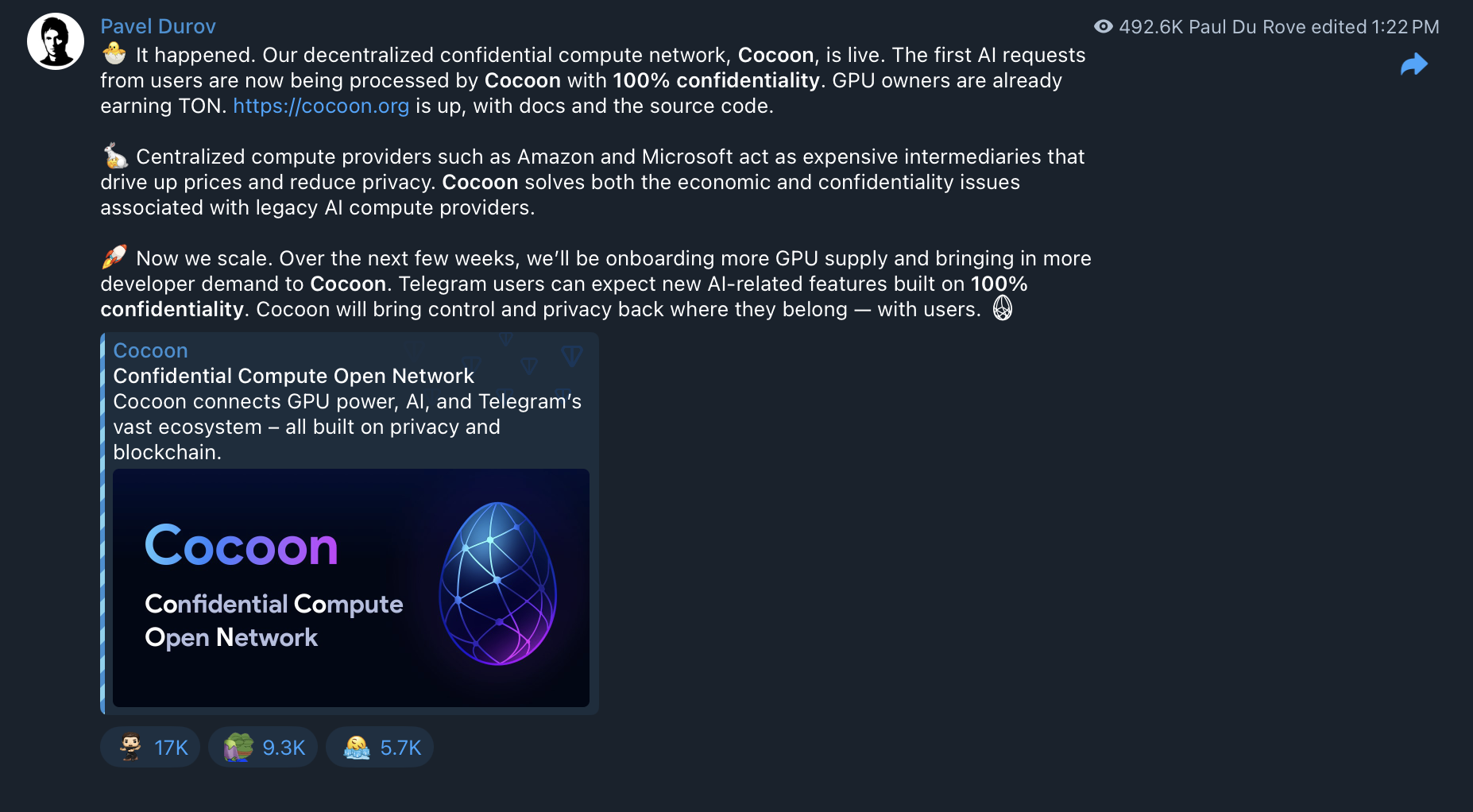
Supply: Pavel Durov
Durov introduced the discharge of Cocoon on the Blockchain Life 2025 convention in Dubai, United Arab Emirates (UAE), in October, as a solution to consumer demand for an AI platform that may defend privateness and information from massive, centralized AI service suppliers.
The blockchain neighborhood, privateness advocates, and cypherpunks have lengthy warned in opposition to the damaging social results of centralized AI, advocating for decentralized AI networks as a public good.
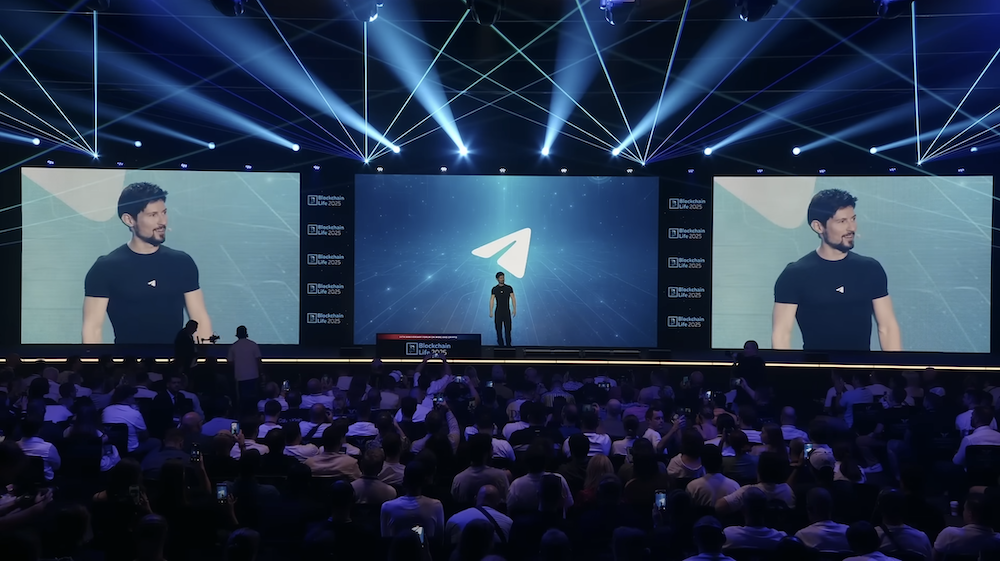
Durov declares Cocoon on the Blockchain Life 2025 convention in Dubai. Supply: Blockchain Life 2025
Associated: Telegram CEO Pavel Durov free to go away France as journey ban lifted: Report
Decentralized AI and self-sovereignty: an antidote to a centralized dystopia
Centralized AI techniques give governments and companies huge leverage over people that may compromise consumer privateness, threaten conventional cybersecurity safeguards, and result in social conditioning by organized actors, David Holtzman, chief technique officer of the Naoris decentralized safety protocol, informed Cointelegraph.
These threats will be mitigated by making use of blockchain expertise to AI to confirm sources of knowledge, guarantee tamper-proof information, and permit nodes on distributed computing networks to speak in a trustless means, he added.
In 2024, AI researchers from the Dfinity Basis, the non-profit group that steers improvement of the Web Laptop Protocol (ICP), and executives from decentralized AI developer Onicai outlined seven guidelines to make sure moral AI.
These included operating AI by permissionless blockchain networks to make sure transparency and information integrity.
A ballot carried out by the Digital Foreign money Group (DCG) in Might confirmed that 77% of the two,036 respondents surveyed stated that decentralized AI would profit society greater than centralized techniques.
Journal: Neglect The Terminator: SingularityNET’s Janet Adams is constructing AGI with coronary heart