
Ethereum’s Fusaka improve is now dwell on mainnet, marking a serious structural change in how the community handles knowledge and scaling. The improve was activated at epoch 411392 at 21:49:11 UTC, with the official Ethereum account first signalling “improve in progress . . . activating Fusaka @ epoch 411392 // 21:49:11 UTC” after which confirming that “Fusaka is dwell on Ethereum mainnet!”
In its announcement, the account highlighted three core parts of Fusaka. PeerDAS “now unlocks 8x knowledge throughput for rollups,” considerably increasing the quantity of knowledge that rollup-based layer 2 networks can publish to the community. The improve additionally introduces “UX enhancements through the R1 curve & pre-confirmations,” and is described as specific “prep for scaling the L1 with gasoline restrict enhance & extra.” The mission added that group members and core builders will “proceed to observe for points over the subsequent 24 hrs.”
Why Fusaka Is ‘Vital’ For Ethereum
Vitalik Buterin framed the core of the improve in unusually direct phrases. “PeerDAS in Fusaka is critical as a result of it actually is sharding,” he wrote. “Ethereum is coming to consensus on blocks with out requiring any single node to see greater than a tiny fraction of the information. And that is sturdy to 51% assaults – it’s client-side probabilistic verification, not validator voting.” In different phrases, the community can now agree on blocks though no node has to obtain all the related knowledge, relying as a substitute on probabilistic verification on the consumer facet.
Buterin tied this to a long-running analysis line, noting that “sharding has been a dream for Ethereum since 2015, and knowledge availability sampling since 2017,” and linking again to early analysis work on knowledge availability and erasure coding. With Fusaka, that structure is not only a roadmap idea however a dwell mechanism securing Ethereum’s knowledge layer.
On the identical time, Buterin was clear that Fusaka doesn’t full the sharding roadmap. He confused that “there are three ways in which the sharding in Fusaka is incomplete.” First, he argued that “we are able to course of O(c^2) transactions (the place c is the per-node compute) on L2s, however not on the ethereum L1,” including that “if we wish to scaling to profit the ethereum L1 as effectively, past what we are able to get by constant-factor upgrades like BAL and ePBS, we want mature ZK-EVMs.”
Second, he pointed to the “proposer/builder bottleneck,” the place “the builder must have the entire knowledge and construct the entire block,” and mentioned “it might be wonderful to have distributed block constructing.” Third, he famous bluntly: “We don’t have a sharded mempool. We nonetheless want that.”
Regardless of these caveats, Buterin known as Fusaka “a basic step ahead in blockchain design.” He argued that “the subsequent two years will give us time to refine the PeerDAS mechanism, rigorously enhance its scale whereas we proceed to make sure its stability, use it to scale L2s, after which when ZK-EVMs are mature, flip it inwards to scale ethereum L1 gasoline as effectively.”
He closed by sending “large congrats to the Ethereum researchers and core devs who labored arduous for years to make this occur,” underscoring that for the Ethereum group, Fusaka shouldn’t be a routine protocol replace however the arrival of a long-promised sharding period on mainnet.
At press time, ETH traded at $3,194.
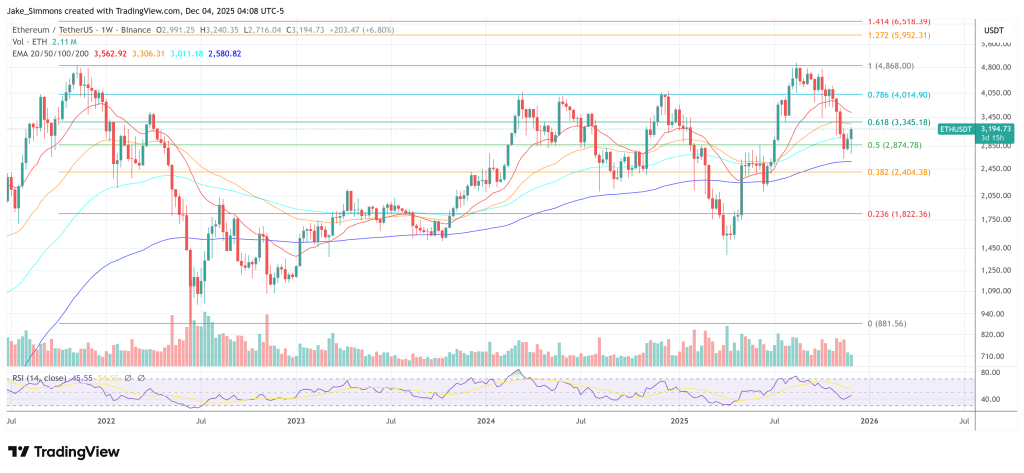
Featured picture created with DALL.E, chart from TradingView.com
Editorial Course of for is centered on delivering completely researched, correct, and unbiased content material. We uphold strict sourcing requirements, and every web page undergoes diligent overview by our staff of prime expertise specialists and seasoned editors. This course of ensures the integrity, relevance, and worth of our content material for our readers.