
Ethereum has rolled out its Fusaka improve, a serious step that lets the community deal with extra transactions whereas prioritizing security and decentralization.
Fusaka facilities on EIP-7594: PeerDAS (Peer Knowledge Availability Sampling), a system that permits Ethereum nodes to confirm that block information is full with out downloading every thing. This will increase the community’s capability whereas retaining it secure and decentralized.
Ethereum – the world’s largest good contract blockchain with a complete worth locked (TVL) of over $73 billion in decentralized finance (DeFi) – processes 1.3 to 1.8 million transactions per day, in keeping with Etherscan information.
ETH is up 5% over the previous 24 hours.
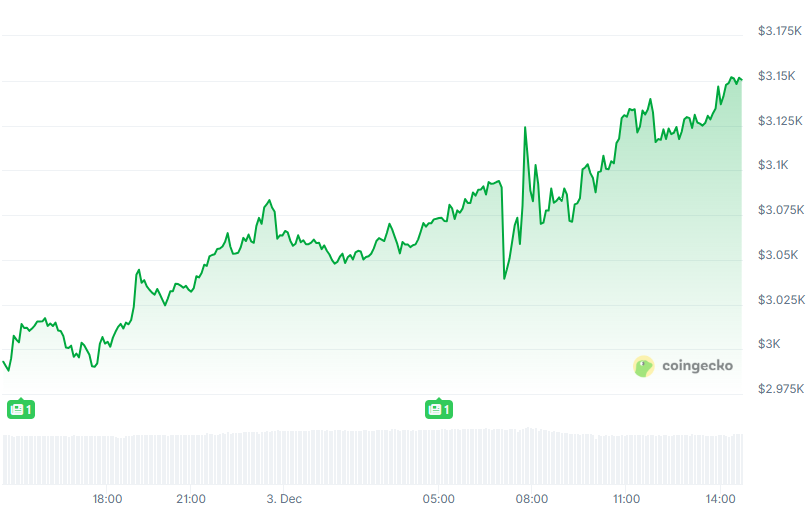
ETH chart
“It makes Ethereum extra scalable with out compromising decentralization. That’s the whole level,” Jason Chaskin, Ethereum Basis Apps Relation Lead, defined to The Defiant. “The trade-off is that this path has taken nearly a decade of analysis and engineering. It’s the exhausting approach to scale a blockchain, but it surely avoids the shortcut of forcing everybody into information facilities.
He added that Fusaka additionally raises the Layer 1 (L1) gasoline restrict from 45 million to 60 million models and introduces an R1 signature precompile, which makes it cheaper and simpler for builders to make use of passkeys in Ethereum apps. For Layer 2 (L2) networks, which have already got very low charges, Fusaka ensures they continue to be that method.
“PeerDAS provides rollups extra blob house, and that house is just going to extend over time,” Chaskin stated. “On pace, L2s are already extraordinarily quick. Arbitrum is about 250 ms, and Base is round 200 ms, for instance.”
The improve is a crucial step in Ethereum’s plan to deal with extra transactions and put together for future enhancements. Since most exercise now occurs on L2s like Base, Optimism, and Arbitrum, decreasing information prices is essential to retaining charges low and supporting extra customers.
“This is step one of L2 information scaling. Ethereum will enhance blob capability slowly and methodically as soon as operators and researchers are assured it’s secure,” Chaskin stated. “The excellent news is these will increase can occur by means of blob-only forks, so we don’t want to attend for an enormous exhausting fork each time.”
He emphasised that the principle danger is that that is new software program operating dwell for the primary time, so the rollout shall be cautious. Nonetheless, he added that for the primary time, Ethereum can have reliably low charges over the long run.
“That adjustments what builders can construct and what customers can count on. When you already know charges will keep below a penny, entire new classes of purposes turn out to be viable,” Chaskin stated. “It makes Ethereum probably the most predictable surroundings to construct in.”
The improve comes just some weeks after the Ethereum Basis revealed new particulars about its upcoming Interop Layer, a system that goals to make the community’s rising Layer 2 (L2) ecosystem work like a single, unified chain.